Country tax rules
Each country's payroll tax configuration: income tax bands, contributions and levies, Tax Settings and sources.
In this guide, and all guides
How to read these tables
Each country's payroll rules exactly as Plutus holds them, taken from the app's own rule sets, not retyped. Nigeria runs on its own rule version. Ghana, Kenya, Rwanda, The Gambia and Côte d'Ivoire run on rule sets Plutus Technologies approved on 27 October 2026 from published sources, before review by a local tax adviser.
- † marks a figure your company sets under Tax Settings. Where the sources offer figures, they are shown; otherwise your company enters its own.
- Outside Nigeria, income tax is worked out on each month's pay on its own, against monthly bands. Nigeria's PAYE is worked out cumulatively over the tax year, against annual bands.
- Each line cites a numbered source, marked Official (the law or the authority's own publication) or Secondary (such as an accounting firm, law firm or payroll vendor).
- VAT, withholding tax and corporate tax for the five newer countries aren't approved yet, so Plutus doesn't calculate them and they aren't listed here.
These are the rules Plutus applies, not tax advice. Check them with a tax adviser in the country before you rely on them.
 (opens full size in a new tab)
Nigeria
- In the app
- Accounts, then Payroll, then Compliance Engine
PAYE
Worked out cumulatively over the tax year on annual chargeable income, and paid to the state tax authority where the employee lives by the 10th of the following month. The first ₦800,000 is tax-free. Rent relief is 20% of the annual rent paid, up to ₦500,000.
| Annual chargeable income | Rate |
|---|---|
| Up to ₦800,000 | 0% |
| ₦800,000 to ₦3,000,000 | 15% |
| ₦3,000,000 to ₦12,000,000 | 18% |
| ₦12,000,000 to ₦25,000,000 | 21% |
| ₦25,000,000 to ₦50,000,000 | 23% |
| Above ₦50,000,000 | 25% |
Contributions and levies
| Scheme | Rate | Base | Paid to | Due |
|---|---|---|---|---|
| Pension | 8% employee, 10% employer | Pensionable pay (basic + housing + transport) | PFA | 7 working days after payment |
| NHF | 2.5% | Basic salary, employee | FMBN | 30 days after payment |
| NSITF | 1% | Pensionable pay, employer cost | NSITF | 16th of the following month |
| ITF | 1% | Annual payroll, employer cost (qualifying employers) | ITF | 1st April |
| WHT | goods 5%, services 10% | Contractor and vendor payments, by category | NRS | 21st of the following month |
Nigeria has no Tax Settings: every figure is built into NG-2026.1, and shown in the app under Compliance Engine.
Ghana
- In the app
- Accounts, then Payroll, then Tax Settings
Approved by Plutus Technologies on 27 October 2026, without a local tax adviser's review.
Ghana, from 1 September 2026 (Income Tax (Amendment) Act 2026, Act 1178).
Built in: the Act 1178 PAYE rates and the GHS 588 monthly threshold, PAYE due on the 15th, and social security at 5.5% employee and 13% employer on basic salary, paid out as the SSNIT Omnibus's worked example pays it: 13.5% to SSNIT (Tier 1) and 5% to the Tier 2 corporate trustee. Entered by each organisation: the monthly PAYE band limits above the threshold (GRA's monthly table wasn't found, and sources disagree where 30% starts), whether SSNIT is deductible before PAYE, the contribution ceiling (sources disagree), and the SSNIT and Tier 2 deadlines.
Periods before 1 September 2026 aren't covered: the earlier schedule wasn't captured, so they're refused.
Income tax
PAYE, paid to Ghana Revenue Authority. Worked out on each month's pay on its own. Due: Day 15 of the following month. [2]
| Monthly taxable income | Rate |
|---|---|
| Up to GHS 588 | 0% |
| GHS 588 to GHS 668† | 5% |
| GHS 668† to GHS 768† | 10% |
| GHS 768† to GHS 3,668† | 17.5% |
| GHS 3,668† to GHS 19,668 or GHS 34,000† | 25% |
| GHS 19,668 or GHS 34,000† to GHS 50,000† | 30% |
| Above GHS 50,000† | 35% |
Contributions, levies and credits
| Line | Paid by | Figure | Paid to | Due | Source |
|---|---|---|---|---|---|
| Social security (SSNIT)SSNIT | Employee | 5.5% of basic salary, up to GHS 69,000 or GHS 5,083.33†Deducted before PAYE if you choose† | Social Security and National Insurance Trust | Day 15 or 14 of the following month† | [4] |
| Social security, Tier 1 (employer)SSNIT-ER | Employer | 8% of basic salary, up to GHS 69,000 or GHS 5,083.33† | Social Security and National Insurance Trust | Day 15 or 14 of the following month† | [3] |
| Occupational pension, Tier 2 (employer)TIER2-ER | Employer | 5% of basic salary, up to GHS 69,000 or GHS 5,083.33† | Tier 2 corporate trustee | A day you choose, of the following month† | [3] |
† Set by your company under Tax Settings. Where the sources give a figure, it is shown; otherwise the company enters its own.
Figures your company enters under Tax Settings (9)
- 1Monthly PAYE: upper limit of the 5% band
Act 1178's 5% band ends at GHS 8,016 a year, as reported; GRA's monthly table wasn't found, and dividing by 12 isn't a substitute for it. Enter the monthly limit from GRA's table.
- 668.00 GHSAct 1178 annual band, divided by 12
Used for: PAYE bands.
- 2Monthly PAYE: upper limit of the 10% band
Act 1178's 10% band ends at GHS 9,216 a year, as reported; GRA's monthly table wasn't found, and dividing by 12 isn't a substitute for it. Enter the monthly limit from GRA's table.
- 768.00 GHSAct 1178 annual band, divided by 12
Used for: PAYE bands.
- 3Monthly PAYE: upper limit of the 17.5% band
Act 1178's 17.5% band ends at GHS 44,016 a year, as reported; GRA's monthly table wasn't found, and dividing by 12 isn't a substitute for it. Enter the monthly limit from GRA's table.
- 3,668.00 GHSAct 1178 annual band, divided by 12
Used for: PAYE bands.
- 4Monthly PAYE: upper limit of the 25% band
Sources disagree where 30% starts: most go straight from 25% to 30% at GHS 236,016 a year; Regfollower reproduces a GRA-style table with 30% from GHS 408,000. GRA's monthly table wasn't found. Enter the monthly limit from GRA's table.
- 19,668.00 GHSMost sources: Mercans, GhanaWeb
- 34,000.00 GHSRegfollower
Used for: PAYE bands.
- 5Monthly PAYE: upper limit of the 30% band
Act 1178's 30% band ends at GHS 600,000 a year, as reported; GRA's monthly table wasn't found, and dividing by 12 isn't a substitute for it. Enter the monthly limit from GRA's table.
- 50,000.00 GHSAct 1178 annual band, divided by 12
Used for: PAYE bands.
- 6Is the employee's 5.5% SSNIT contribution deducted before PAYE?
No source found says whether the employee's social security contribution comes off pay before PAYE.
- YesYour organisation's practice
- NoYour organisation's practice
Used for: Social security (SSNIT).
- 7Monthly ceiling on basic salary for social security
Sources disagree: GHS 69,000 a month in one, GHS 61,000 a year in another.
- 69,000.00 GHSSecondary source
- 5,083.33 GHSSecondary source
Used for: Social security (SSNIT), Social security, Tier 1 (employer), Occupational pension, Tier 2 (employer).
- 8Day of the following month SSNIT (Tier 1) is due
Most sources say the 15th; one payroll vendor says the 14th (unverified).
- 15Several secondary sources
- 14One payroll vendor (unverified)
Used for: Social security (SSNIT), Social security, Tier 1 (employer).
- 9Day of the following month the Tier 2 contribution is due
No source found gives the deadline for paying the Tier 2 corporate trustee.
Entered by your company, from 1 to 28.
Used for: Occupational pension, Tier 2 (employer).
Sources
- [1]OfficialGRA, Amendments: Income Tax (Amendment) Act, 2026 (Act 1178), new rates from 1 September 2026; first GHS 7,056 a year at 0%https://gra.gov.gh/news/portfolio/amendments-income-tax-act-2026-act-1178/
- [2]SecondaryAct 1178 annual bands and the GHS 588 monthly threshold, as reported (Mercans, Regfollower, GhanaWeb, TaxLawGH)https://mercans.com/resources/statutory-alerts/ghana-revised-personal-income-tax-paye-rates-1st-september-2026/
- [3]OfficialSSNIT, Omnibus: worked example paying 13.5% of basic salary to SSNIT (Tier 1) and 5% to the Tier 2 trusteehttps://www.ssnit.org.gh/wp-content/uploads/2023/08/SSNIT-Omnibus.pdf
- [4]SecondaryNational Pensions Act 2008 (Act 766) rates: 5.5% employee and 13% employer of basic salary, as reported (several secondary sources)https://www.taxlawgh.com/ghana-tax-rates
- [5]SecondaryEntered by your organisation under Tax SettingsPlutus Tax Settings
Kenya
- In the app
- Accounts, then Payroll, then Tax Settings
Approved by Plutus Technologies on 27 October 2026, without a local tax adviser's review.
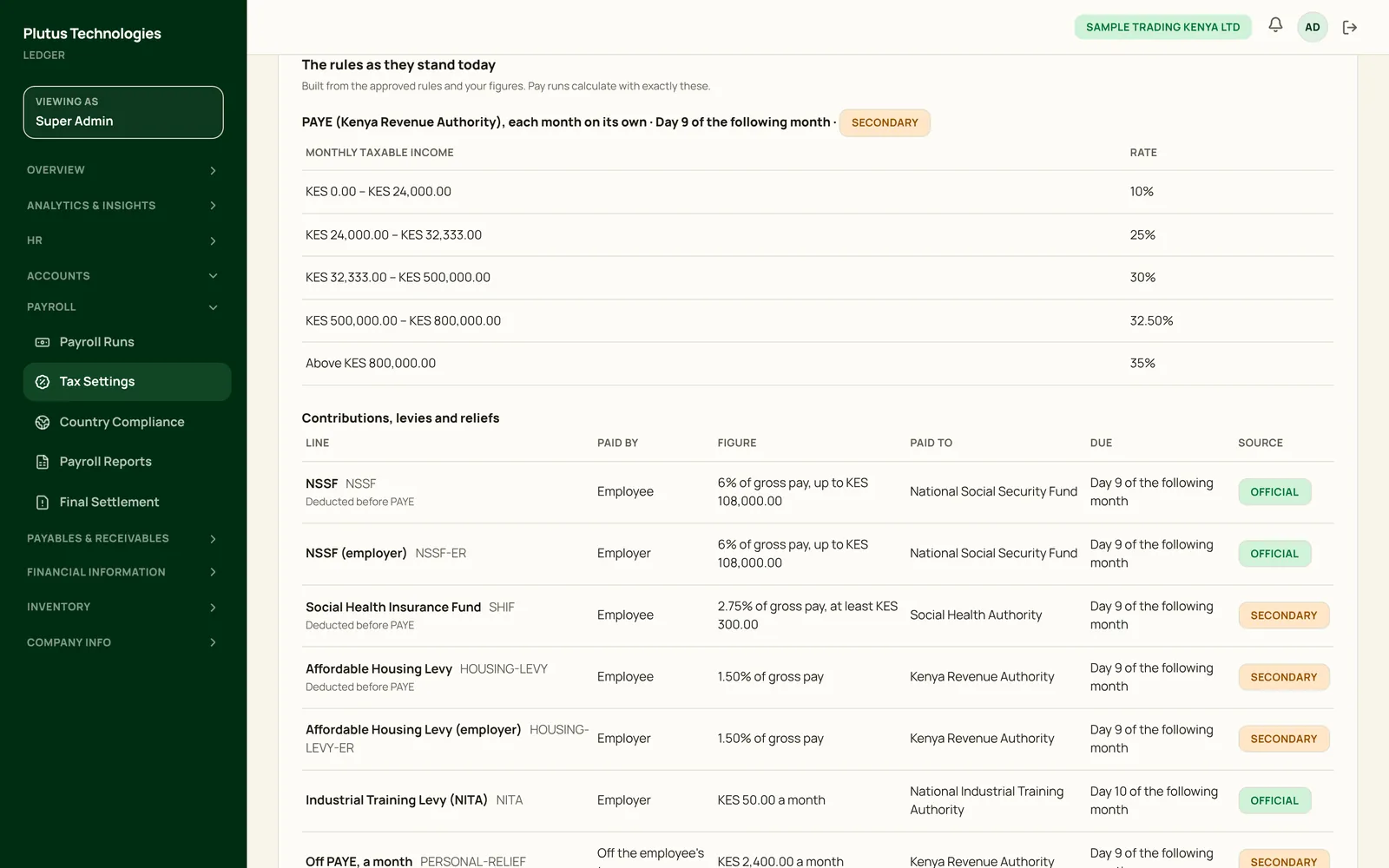
Kenya, from February 2026 (NSSF Year 4 rates).
Built in: the PAYE bands and personal relief, what's deductible before PAYE under KRA's December 2024 notice, NSSF, SHIF, the Affordable Housing Levy and the NITA levy's amount. Entered by each organisation: whether NSSF is deductible before PAYE (no source settles it), whether it pays the NITA levy and when it's due (sources disagree). Mortgage interest and post-retirement medical fund deductions are voluntary and aren't modelled.
Income tax
PAYE, paid to Kenya Revenue Authority. Worked out on each month's pay on its own. Due: Day 9 of the following month. [2]
| Monthly taxable income | Rate |
|---|---|
| Up to KES 24,000 | 10% |
| KES 24,000 to KES 32,333 | 25% |
| KES 32,333 to KES 500,000 | 30% |
| KES 500,000 to KES 800,000 | 32.5% |
| Above KES 800,000 | 35% |
Contributions, levies and credits
| Line | Paid by | Figure | Paid to | Due | Source |
|---|---|---|---|---|---|
| NSSFNSSF | Employee | 6% of gross pay, up to KES 108,000Deducted before PAYE if you choose† | National Social Security Fund | Day 9 of the following month | [3] |
| NSSF (employer)NSSF-ER | Employer | 6% of gross pay, up to KES 108,000 | National Social Security Fund | Day 9 of the following month | [3] |
| Social Health Insurance FundSHIF | Employee | 2.75% of gross pay, at least KES 300Deducted before PAYE | Social Health Authority | Day 9 of the following month | [4] |
| Affordable Housing LevyHOUSING-LEVY | Employee | 1.5% of gross payDeducted before PAYE | Kenya Revenue Authority | Day 9 of the following month | [5] |
| Affordable Housing Levy (employer)HOUSING-LEVY-ER | Employer | 1.5% of gross pay | Kenya Revenue Authority | Day 9 of the following month | [5] |
| Industrial Training Levy (NITA)NITA | Employer | KES 50 a head, a monthOnly where your Tax Settings include it† | National Industrial Training Authority | Day 5 or 10 of the following month† | [6] |
| Personal reliefPERSONAL-RELIEF | Tax credit | KES 2,400 off PAYE a month | Kenya Revenue Authority | Day 9 of the following month | [2] |
† Set by your company under Tax Settings. Where the sources give a figure, it is shown; otherwise the company enters its own.
Figures your company enters under Tax Settings (3)
- 1Is the employee's NSSF contribution deducted before PAYE?
KRA's December 2024 notice lets pension contributions up to KES 30,000 a month come off pay before PAYE, but doesn't name NSSF. The Finance Committee chair said in June 2024 that NSSF savings would be deductible.
- Yes, within the KES 30,000 a month pension capFinance Committee chair, June 2024 debate (reported)
- NoKRA's December 2024 notice doesn't name NSSF
Used for: NSSF.
- 2Does your organisation pay the NITA industrial training levy?
Sources disagree on which employers must pay: one says those with more than 20 employees, another those with 100 or more. Hotels and restaurants paying the catering levy are exempt.
- YesNITA levy FAQ
- NoExempt, or below the threshold that applies to you
Used for: Industrial Training Levy (NITA).
- 3Day of the following month the NITA levy is due
Sources disagree: the 5th (Industrial Training (Amendment) Act 2022, as reported) or the 10th (older guidance) of the following month. NITA's FAQ says the last working day of the month itself; Plutus records a day of the following month.
- 5Industrial Training (Amendment) Act 2022, as reported
- 10Older NITA guidance
Only needed when “Does your organisation pay the NITA industrial training levy?” is Yes. Used for: Industrial Training Levy (NITA).
Sources
- [1]OfficialKRA, Amendments to PAYE computation pursuant to the Tax Laws (Amendment) Act, 2024 (deductions before PAYE, from December 2024 payroll)https://www.kra.go.ke/news-center/public-notices/2157-amendments-to-paye-computation-pursuant-to-the-tax-laws-amendment-act%2C-2024
- [2]SecondaryPAYE bands (Finance Act 2023) and personal relief, as reported for 2026 (Business Radar and other secondary sources)https://businessradar.co.ke/?p=9779
- [3]OfficialNSSF, Notice to employers: Year 4 (2026) contribution rates, from February 2026https://www.nssf.or.ke/notice-to-employers-year-4-2026-nssf-contribution-rates
- [4]SecondarySocial Health Insurance Act 2023 and regulations of 8 March 2024, as reported (EY)https://www.ey.com/en_gl/technical/tax-alerts/kenya-employers-to-begin-making-contributions-to-social-health-insurance-fund
- [5]SecondaryAffordable Housing Act 2024, as reported (Business Daily)https://www.businessdailyafrica.com/bd/economy/workers-gain-as-kra-grants-tax-relief-on-housing-levy-shif-4863782
- [6]OfficialNITA, levy FAQ (KES 50 per employee a month)https://www.nita.go.ke/faq-s/99-nita-services
- [7]SecondaryEntered by your organisation under Tax SettingsPlutus Tax Settings
Rwanda
- In the app
- Accounts, then Payroll, then Tax Settings
Two rule sets: one for 2026, and one from 1 January 2027, when the RSSB pension rises to 14% in all and your company enters the employee's share. The 2026 settings carry over.
Approved by Plutus Technologies on 27 October 2026, without a local tax adviser's review.
Rwanda, 2026 and 2027.
Built in: the four-band PAYE schedule of Law No. 027/2022 (0%, 10%, 20% and 30%, with cut-offs at RWF 60,000, 100,000 and 200,000 a month; the three-band schedule some guides still show was the law's first year only), RSSB pension on gross pay including transport (6% employee and 6% employer in 2026; 14% in all from 1 January 2027, under Presidential Order No. 086/01 of 2024), RSSB maternity leave at 0.3% from the employer, CBHI at 0.5% of the employee's net pay (RRA, citing Prime Minister's Order No. 034/01 of 2020), and the 15th as the deadline for PAYE, RSSB and CBHI. Entered by each organisation: whether RSSB contributions are deducted before PAYE, the employee's maternity rate (sources disagree), what maternity and occupational hazards are charged on, the occupational hazards rate (sources disagree), and, from 2027, the employee's share of the 14% pension (the order doesn't divide it; the employer pays the rest).
Pension rises again to 16% in January 2028, so 2028 periods are refused until a rule set for 2028 is added.
Income tax
PAYE, paid to Rwanda Revenue Authority. Worked out on each month's pay on its own. Due: Day 15 of the following month. [1]
| Monthly taxable income | Rate |
|---|---|
| Up to RWF 60,000 | 0% |
| RWF 60,000 to RWF 100,000 | 10% |
| RWF 100,000 to RWF 200,000 | 20% |
| Above RWF 200,000 | 30% |
Contributions, levies and credits
| Line | Paid by | Figure | Paid to | Due | Source |
|---|---|---|---|---|---|
| RSSB pensionRSSB-PENSION | Employee | 6% of gross payDeducted before PAYE if you choose† | Rwanda Social Security Board | Day 15 of the following month | [2] |
| RSSB pension (employer)RSSB-PENSION-ER | Employer | 6% of gross pay | Rwanda Social Security Board | Day 15 of the following month | [2] |
| RSSB maternity leaveRSSB-MATERNITY | Employee | 0.3% of gross pay or basic salary plus fixed allowances or basic salary†Deducted before PAYE if you choose†Only where your Tax Settings include it† | Rwanda Social Security Board | Day 15 of the following month | [9] |
| RSSB maternity leave (employer)RSSB-MATERNITY-ER | Employer | 0.3% of gross pay or basic salary plus fixed allowances or basic salary† | Rwanda Social Security Board | Day 15 of the following month | [3] |
| RSSB occupational hazards (employer)RSSB-HAZARDS-ER | Employer | 2% or 1% or 0.5%† of gross pay or basic salary plus fixed allowances or basic salary† | Rwanda Social Security Board | Day 15 of the following month | [9] |
| Community-based health insuranceCBHI | Employee | 0.5% of net pay | Rwanda Social Security Board | Day 15 of the following month | [4] |
† Set by your company under Tax Settings. Where the sources give a figure, it is shown; otherwise the company enters its own.
Figures your company enters under Tax Settings (5)
- 1Are the employee's RSSB pension and maternity contributions deducted before PAYE?
No statute found says. One payroll vendor works out PAYE on gross pay and takes the contributions off afterwards, but that is its method, not the law.
- NoOne payroll vendor's method
- YesYour organisation's practice
Used for: RSSB maternity leave, RSSB pension.
- 2Employee's RSSB maternity leave rate
Most sources give 0.3% from the employee as well as 0.3% from the employer; one gives 0% from the employee.
- 0.3%Most sources
- 0%One source
Used for: RSSB maternity leave.
- 3What RSSB maternity leave is charged on
No source found gives the base for maternity leave contributions.
- Gross pay, as for RSSB pensionYour organisation's practice: no source gives the maternity base
- Basic salary plus fixed allowancesYour organisation's practice: no source gives the maternity base
- Basic salaryYour organisation's practice: no source gives the maternity base
Used for: RSSB maternity leave, RSSB maternity leave (employer).
- 4Employer's occupational hazards rate
Sources disagree: 2%, 1% or 0.5%, paid by the employer.
- 2%Secondary source
- 1%Secondary source
- 0.5%Secondary source
Used for: RSSB occupational hazards (employer).
- 5What occupational hazards contributions are charged on
No source found gives the base for occupational hazards contributions.
- Gross pay, as for RSSB pensionYour organisation's practice: no source gives the occupational hazards base
- Basic salary plus fixed allowancesYour organisation's practice: no source gives the occupational hazards base
- Basic salaryYour organisation's practice: no source gives the occupational hazards base
Used for: RSSB occupational hazards (employer).
Sources
- [1]SecondaryLaw No. 027/2022 on taxes on income, four-bracket schedule from November 2023, as reported (Orbitax; PwC Worldwide Tax Summaries)https://taxsummaries.pwc.com/rwanda/individual/taxes-on-personal-income
- [2]SecondaryRSSB pension 6% employee and 6% employer on gross pay including transport, from January 2025, as reported (Sage, PaySpace, The New Times)https://support.payspace.com/portal/en/kb/articles/rwanda-pension-reforms-effective-january-2025
- [3]SecondaryRSSB maternity leave 0.3% employer; employee 0.3% in most sources, 0% in one, as reported (payroll guides)https://www.playroll.com/payroll/rwanda
- [4]OfficialRRA, CBHI contribution: under Prime Minister's Order No. 034/01 of 13/01/2020, the employee contributes 0.5% of net salary, deducted and paid by the employerhttps://www.rra.gov.rw/en/domestic-tax-services/rssb-contributions/cbhi-contribution
- [5]SecondaryEY, Rwanda establishes subsidy contributions from employees for the community-based health insurance scheme: remitted to RSSB by the 15th of the following monthhttps://globaltaxnews.ey.com/news/2020-5351-rwanda-establishes-subsidy-contributions-from-employees-for-community-based-health-insurance-scheme
- [6]SecondaryPAYE and RSSB contributions declared to RRA by the 15th of the following month, as reported (several secondary sources)https://www.rivermate.com/guides/rwanda/taxes
- [7]OfficialPresidential Order No. 086/01 of 12 December 2024 on the pension scheme: contributions of 12% from 1 January 2025 and 14% from 1 January 2027 (official text, ILO NATLEX copy)https://natlex.ilo.org/dyn/natlex2/natlex2/files/download/117567/RWA-117567.pdf
- [8]OfficialRSSB, Frequently asked questions: employer and employee contribute equally to the pension schemehttps://www.rssb.rw/uploads/RSSB_FAQS_All_languages_2_760b75b195.pdf
- [9]SecondaryEntered by your organisation under Tax SettingsPlutus Tax Settings
Approved by Plutus Technologies on 27 October 2026, without a local tax adviser's review.
Rwanda, 2026 and 2027.
Built in: the four-band PAYE schedule of Law No. 027/2022 (0%, 10%, 20% and 30%, with cut-offs at RWF 60,000, 100,000 and 200,000 a month; the three-band schedule some guides still show was the law's first year only), RSSB pension on gross pay including transport (6% employee and 6% employer in 2026; 14% in all from 1 January 2027, under Presidential Order No. 086/01 of 2024), RSSB maternity leave at 0.3% from the employer, CBHI at 0.5% of the employee's net pay (RRA, citing Prime Minister's Order No. 034/01 of 2020), and the 15th as the deadline for PAYE, RSSB and CBHI. Entered by each organisation: whether RSSB contributions are deducted before PAYE, the employee's maternity rate (sources disagree), what maternity and occupational hazards are charged on, the occupational hazards rate (sources disagree), and, from 2027, the employee's share of the 14% pension (the order doesn't divide it; the employer pays the rest).
Pension rises again to 16% in January 2028, so 2028 periods are refused until a rule set for 2028 is added.
Income tax
PAYE, paid to Rwanda Revenue Authority. Worked out on each month's pay on its own. Due: Day 15 of the following month. [1]
| Monthly taxable income | Rate |
|---|---|
| Up to RWF 60,000 | 0% |
| RWF 60,000 to RWF 100,000 | 10% |
| RWF 100,000 to RWF 200,000 | 20% |
| Above RWF 200,000 | 30% |
Contributions, levies and credits
| Line | Paid by | Figure | Paid to | Due | Source |
|---|---|---|---|---|---|
| RSSB pensionRSSB-PENSION | Employee | 7% or 6%† of gross payDeducted before PAYE if you choose† | Rwanda Social Security Board | Day 15 of the following month | [7] |
| RSSB pension (employer)RSSB-PENSION-ER | Employer | 7% or 8%† of gross pay | Rwanda Social Security Board | Day 15 of the following month | [7] |
| RSSB maternity leaveRSSB-MATERNITY | Employee | 0.3% of gross pay or basic salary plus fixed allowances or basic salary†Deducted before PAYE if you choose†Only where your Tax Settings include it† | Rwanda Social Security Board | Day 15 of the following month | [9] |
| RSSB maternity leave (employer)RSSB-MATERNITY-ER | Employer | 0.3% of gross pay or basic salary plus fixed allowances or basic salary† | Rwanda Social Security Board | Day 15 of the following month | [3] |
| RSSB occupational hazards (employer)RSSB-HAZARDS-ER | Employer | 2% or 1% or 0.5%† of gross pay or basic salary plus fixed allowances or basic salary† | Rwanda Social Security Board | Day 15 of the following month | [9] |
| Community-based health insuranceCBHI | Employee | 0.5% of net pay | Rwanda Social Security Board | Day 15 of the following month | [4] |
† Set by your company under Tax Settings. Where the sources give a figure, it is shown; otherwise the company enters its own.
Figures your company enters under Tax Settings (6)
- 1Are the employee's RSSB pension and maternity contributions deducted before PAYE?
No statute found says. One payroll vendor works out PAYE on gross pay and takes the contributions off afterwards, but that is its method, not the law.
- NoOne payroll vendor's method
- YesYour organisation's practice
Used for: RSSB maternity leave, RSSB pension.
- 2Employee's RSSB maternity leave rate
Most sources give 0.3% from the employee as well as 0.3% from the employer; one gives 0% from the employee.
- 0.3%Most sources
- 0%One source
Used for: RSSB maternity leave.
- 3What RSSB maternity leave is charged on
No source found gives the base for maternity leave contributions.
- Gross pay, as for RSSB pensionYour organisation's practice: no source gives the maternity base
- Basic salary plus fixed allowancesYour organisation's practice: no source gives the maternity base
- Basic salaryYour organisation's practice: no source gives the maternity base
Used for: RSSB maternity leave, RSSB maternity leave (employer).
- 4Employer's occupational hazards rate
Sources disagree: 2%, 1% or 0.5%, paid by the employer.
- 2%Secondary source
- 1%Secondary source
- 0.5%Secondary source
Used for: RSSB occupational hazards (employer).
- 5What occupational hazards contributions are charged on
No source found gives the base for occupational hazards contributions.
- Gross pay, as for RSSB pensionYour organisation's practice: no source gives the occupational hazards base
- Basic salary plus fixed allowancesYour organisation's practice: no source gives the occupational hazards base
- Basic salaryYour organisation's practice: no source gives the occupational hazards base
Used for: RSSB occupational hazards (employer).
- 6Employee's share of the 14% RSSB pension contribution in 2027
Presidential Order No. 086/01 of 2024 raises the pension contribution to 14% from 1 January 2027 without dividing it between employer and employee. RSSB says both contribute equally (7% each); payroll guidance says an employer may instead pay the employee's increase (6% from the employee, 8% from the employer). The employer pays the rest of the 14%.
- 7%RSSB FAQ: employer and employee contribute equally
- 6%Payroll guidance (Sage), as reported
Used for: RSSB pension, RSSB pension (employer).
Sources
- [1]SecondaryLaw No. 027/2022 on taxes on income, four-bracket schedule from November 2023, as reported (Orbitax; PwC Worldwide Tax Summaries)https://taxsummaries.pwc.com/rwanda/individual/taxes-on-personal-income
- [2]SecondaryRSSB pension 6% employee and 6% employer on gross pay including transport, from January 2025, as reported (Sage, PaySpace, The New Times)https://support.payspace.com/portal/en/kb/articles/rwanda-pension-reforms-effective-january-2025
- [3]SecondaryRSSB maternity leave 0.3% employer; employee 0.3% in most sources, 0% in one, as reported (payroll guides)https://www.playroll.com/payroll/rwanda
- [4]OfficialRRA, CBHI contribution: under Prime Minister's Order No. 034/01 of 13/01/2020, the employee contributes 0.5% of net salary, deducted and paid by the employerhttps://www.rra.gov.rw/en/domestic-tax-services/rssb-contributions/cbhi-contribution
- [5]SecondaryEY, Rwanda establishes subsidy contributions from employees for the community-based health insurance scheme: remitted to RSSB by the 15th of the following monthhttps://globaltaxnews.ey.com/news/2020-5351-rwanda-establishes-subsidy-contributions-from-employees-for-community-based-health-insurance-scheme
- [6]SecondaryPAYE and RSSB contributions declared to RRA by the 15th of the following month, as reported (several secondary sources)https://www.rivermate.com/guides/rwanda/taxes
- [7]OfficialPresidential Order No. 086/01 of 12 December 2024 on the pension scheme: contributions of 12% from 1 January 2025 and 14% from 1 January 2027 (official text, ILO NATLEX copy)https://natlex.ilo.org/dyn/natlex2/natlex2/files/download/117567/RWA-117567.pdf
- [8]OfficialRSSB, Frequently asked questions: employer and employee contribute equally to the pension schemehttps://www.rssb.rw/uploads/RSSB_FAQS_All_languages_2_760b75b195.pdf
- [9]SecondaryEntered by your organisation under Tax SettingsPlutus Tax Settings
The Gambia
- In the app
- Accounts, then Payroll, then Tax Settings
Approved by Plutus Technologies on 27 October 2026, without a local tax adviser's review.
The Gambia, from January 2026.
Built in: GRA's PAYE rates and its GMD 3,000 monthly threshold, NPF at 5% employee and 10% employer on basic salary, and the IICF's 1% capped at GMD 15. Entered by each organisation: the monthly PAYE band limits above the threshold (GRA publishes annual bands), whether NPF is deductible before PAYE, what "total earnings" means for the IICF and when it's due, and whether the organisation is in the Federated Pension Scheme.
Not modelled: fringe benefits tax (Plutus doesn't record benefits in kind) and the expatriate quota (an annual per-person charge).
Income tax
PAYE, paid to Gambia Revenue Authority. Worked out on each month's pay on its own. Due: Day 15 of the following month. [1]
| Monthly taxable income | Rate |
|---|---|
| Up to GMD 3,000 | 0% |
| GMD 3,000 to GMD 3,833.33† | 5% |
| GMD 3,833.33† to GMD 4,666.67† | 10% |
| GMD 4,666.67† to GMD 5,500† | 15% |
| GMD 5,500† to GMD 6,333.33† | 20% |
| Above GMD 6,333.33† | 25% |
Contributions, levies and credits
| Line | Paid by | Figure | Paid to | Due | Source |
|---|---|---|---|---|---|
| National Provident FundNPF | Employee | 5% of basic salaryDeducted before PAYE if you choose† | Social Security and Housing Finance Corporation | Day 15 of the following month | [3] |
| National Provident Fund (employer)NPF-ER | Employer | 10% of basic salary | Social Security and Housing Finance Corporation | Day 15 of the following month | [4] |
| Industrial Injury Compensation FundIICF | Employer | 1% of basic salary plus fixed allowances or gross pay†, at most GMD 15 | Social Security and Housing Finance Corporation | A day you choose, of the following month† | [5] |
| Federated Pension SchemeFPS | Employer | 15% of basic salary plus fixed allowancesOnly where your Tax Settings include it† | Social Security and Housing Finance Corporation | A day you choose, of the following month† | [4] |
† Set by your company under Tax Settings. Where the sources give a figure, it is shown; otherwise the company enters its own.
Figures your company enters under Tax Settings (9)
- 1Monthly PAYE: upper limit of the 5% band
GRA publishes the 5% band as ending at GMD 46,000 a year; its monthly table wasn't found. Enter the monthly limit you apply, for example the annual figure divided by 12.
- 3,833.33 GMDGRA annual band, divided by 12
Used for: PAYE bands.
- 2Monthly PAYE: upper limit of the 10% band
GRA publishes the 10% band as ending at GMD 56,000 a year; its monthly table wasn't found. Enter the monthly limit you apply, for example the annual figure divided by 12.
- 4,666.67 GMDGRA annual band, divided by 12
Used for: PAYE bands.
- 3Monthly PAYE: upper limit of the 15% band
GRA publishes the 15% band as ending at GMD 66,000 a year; its monthly table wasn't found. Enter the monthly limit you apply, for example the annual figure divided by 12.
- 5,500.00 GMDGRA annual band, divided by 12
Used for: PAYE bands.
- 4Monthly PAYE: upper limit of the 20% band
GRA publishes the 20% band as ending at GMD 76,000 a year; its monthly table wasn't found. Enter the monthly limit you apply, for example the annual figure divided by 12.
- 6,333.33 GMDGRA annual band, divided by 12
Used for: PAYE bands.
- 5Is the employee's NPF contribution deducted before PAYE?
No source found says whether the employee's 5% NPF contribution comes off pay before PAYE.
- YesYour organisation's practice
- NoYour organisation's practice
Used for: National Provident Fund.
- 6What the IICF's 1% is charged on
SSHFC says 1% of "total earnings" without defining them; one guide says basic salary plus fixed allowances.
- Basic salary plus fixed allowancesPayroll guide (Africarrières)
- All cash earningsSSHFC: "total earnings"
Used for: Industrial Injury Compensation Fund.
- 7Day of the following month the IICF contribution is due
No source found gives the IICF deadline.
Entered by your company, from 1 to 28.
Used for: Industrial Injury Compensation Fund.
- 8Is your organisation in the Federated Pension Scheme?
SSHFC's Federated Pension Scheme is 15% of gross salary (basic plus fixed allowances), paid by the employer. Which employers it covers wasn't found.
- YesSSHFC; National Audit Office report
- NoYour organisation isn't in the scheme
Used for: Federated Pension Scheme.
- 9Day of the following month the Federated Pension Scheme contribution is due
No source found gives the Federated Pension Scheme deadline.
Entered by your company, from 1 to 28.
Only needed when “Is your organisation in the Federated Pension Scheme?” is Yes. Used for: Federated Pension Scheme.
Sources
- [1]OfficialGRA, employment income tax brochure: 0% to 25%, bands at GMD 36,000, 46,000, 56,000, 66,000 and 76,000 a year, as at January 2018 (quoted by search)https://www.gra.gm/download-file/8d0ccc58-d217-11ed-9b31-029254d29bb1
- [2]OfficialGRA, Domestic taxes FAQs: tax-free GMD 36,000 a year, GMD 3,000 a month (quoted by search)https://www.gra.gm/domestic-faqs
- [3]OfficialSSHFC, overview: NPF employee contribution 5% of basic salary (quoted by search)https://www.sshfc.gm/overview
- [4]OfficialNational Audit Office, performance audit of SSHFC: NPF employer 10%; Federated Pension Scheme 15% of gross salary, employer-paidhttps://nao.gm/wp-content/uploads/2023/04/Performance-Audit-Report-on-the-Management-of-Social-Security-Funds-by-SSHFC.pdf
- [5]OfficialSSHFC, Industrial Injury Compensation Fund: 1% of total earnings, ceiling GMD 15, employer-paid (quoted by search)https://www.sshfc.gm/industrial-injury-compensation-fund
- [6]SecondaryAfrotools, Gambia employer payroll compliance 2026: PAYE and NPF due by the 15thhttps://afrotools.com/blog/gambia-employer-payroll-compliance-2026/
- [7]SecondaryEntered by your organisation under Tax SettingsPlutus Tax Settings
Côte d'Ivoire
- In the app
- Accounts, then Payroll, then Tax Settings
Approved by Plutus Technologies on 27 October 2026, without a local tax adviser's review.
Côte d'Ivoire, for 2026.
Built in: the six-band ITS schedule (Ordonnance No. 2023-719, from 2024), its family reduction (RICF: XOF 5,500 a month for each half-share above one share, counting up to five shares), CNPS retirement at 6.3% employee and 7.7% employer, maternity at 0.75% from the employer, and universal health cover (CMU) at XOF 1,000 a month. Entered by each organisation, where no source settles them or sources disagree: what CNPS contributions are charged on, the retirement ceiling, the family benefits rate, the ceiling on family benefits, maternity and work accidents, the employer's work accident rate, the employee's share of CMU, the training levy rates, the employer tax on salaries, and every deadline.
ITS needs each employee's family shares, and the employer tax on salaries whether each is an expatriate: payroll refuses an employee without them. CMU is charged for the employee only; dependants' cover isn't included.
Income tax
Impôt sur les traitements et salaires (ITS), paid to Direction Générale des Impôts. Worked out on each month's pay on its own. Due: A day you choose, of the following month†. [1]
| Monthly taxable income | Rate |
|---|---|
| Up to XOF 75,000 | 0% |
| XOF 75,000 to XOF 240,000 | 16% |
| XOF 240,000 to XOF 800,000 | 21% |
| XOF 800,000 to XOF 2,400,000 | 24% |
| XOF 2,400,000 to XOF 8,000,000 | 28% |
| Above XOF 8,000,000 | 32% |
Contributions, levies and credits
| Line | Paid by | Figure | Paid to | Due | Source |
|---|---|---|---|---|---|
| CNPS retirementCNPS-RETIREMENT | Employee | 6.3% of gross pay or basic salary plus fixed allowances or basic salary†, up to XOF 3,375,000 or XOF 1,647,315† | Caisse Nationale de Prévoyance Sociale | A day you choose, of the following month† | [2] |
| CNPS retirement (employer)CNPS-RETIREMENT-ER | Employer | 7.7% of gross pay or basic salary plus fixed allowances or basic salary†, up to XOF 3,375,000 or XOF 1,647,315† | Caisse Nationale de Prévoyance Sociale | A day you choose, of the following month† | [2] |
| CNPS family benefits (employer)CNPS-FAMILY-ER | Employer | 5% or 5.75%† of gross pay or basic salary plus fixed allowances or basic salary†, up to a ceiling you enter† | Caisse Nationale de Prévoyance Sociale | A day you choose, of the following month† | [3] |
| CNPS maternity (employer)CNPS-MATERNITY-ER | Employer | 0.75% of gross pay or basic salary plus fixed allowances or basic salary†, up to a ceiling you enter† | Caisse Nationale de Prévoyance Sociale | A day you choose, of the following month† | [2] |
| CNPS work accidents (employer)CNPS-ACCIDENT-ER | Employer | A rate you enter† of gross pay or basic salary plus fixed allowances or basic salary†, up to a ceiling you enter† | Caisse Nationale de Prévoyance Sociale | A day you choose, of the following month† | [3] |
| Universal health cover (CMU, employer)CMU-ER | Employer | An amount set by your Tax Settings† a head, a monthOnly where your Tax Settings include it† | Caisse Nationale de Prévoyance Sociale | A day you choose, of the following month† | [3] |
| Employer tax on salaries (local staff)SALARY-TAX-LOCAL-ER | Employer | 2.8% or 1.2%† of gross pay, local staff only | Direction Générale des Impôts | A day you choose, of the following month† | [3] |
| Employer tax on salaries (expatriates)SALARY-TAX-EXPAT-ER | Employer | 12% or 10.4%† of gross pay, expatriates only | Direction Générale des Impôts | A day you choose, of the following month† | [3] |
| Apprenticeship tax (FDFP)FDFP-APPRENTICESHIP | Employer levy | 0.4% or 0.5%† of gross pay | Fonds de Développement de la Formation Professionnelle | A day you choose, of the following month† | [3] |
| Continuing-training tax (FDFP)FDFP-TRAINING | Employer levy | 1.2% or 1.5%† of gross pay | Fonds de Développement de la Formation Professionnelle | A day you choose, of the following month† | [3] |
| Family tax reduction (RICF)RICF | Tax credit | XOF 5,500 off ITS for each family half-share above one share | Direction Générale des Impôts | A day you choose, of the following month† | [1] |
| Universal health cover (CMU)CMU | Employee | An amount set by your Tax Settings† a head, a monthOnly where your Tax Settings include it† | Caisse Nationale de Prévoyance Sociale | Day 1 of the following month | [3] |
† Set by your company under Tax Settings. Where the sources give a figure, it is shown; otherwise the company enters its own.
Figures your company enters under Tax Settings (12)
- 1What CNPS contributions are charged on
No source found states the pay CNPS contributions are charged on. The ITS is charged on gross pay.
- Gross payYour organisation's practice
- Basic salary plus fixed allowancesYour organisation's practice
- Basic salaryYour organisation's practice
Used for: Universal health cover (CMU, employer), CNPS work accidents (employer), CNPS family benefits (employer), CNPS maternity (employer), CNPS retirement, CNPS retirement (employer).
- 2Monthly ceiling for CNPS retirement contributions
Sources disagree: XOF 3,375,000 a month (CLEISS, rates at 1 January 2025) or XOF 1,647,315 a month (a 2026 source).
- 3,375,000 XOFCLEISS, rates at 1 January 2025
- 1,647,315 XOFA 2026 source
Used for: CNPS retirement, CNPS retirement (employer).
- 3Employer's CNPS family benefits rate
Sources disagree: 5% (CLEISS 2025) or 5.75% (a 2026 source). 5.75% may be 5% plus the 0.75% maternity rate reported together; maternity is charged separately here, so choose 5% if that's the case.
- 5%CLEISS, rates at 1 January 2025
- 5.75%A 2026 source
Used for: CNPS family benefits (employer).
- 4Monthly ceiling for family benefits, maternity and work accidents
No source found gives the ceiling for these CNPS branches. Enter the monthly ceiling CNPS applies to your organisation.
Entered by your company, at least 1 XOF.
Used for: CNPS work accidents (employer), CNPS family benefits (employer), CNPS maternity (employer).
- 5Employer's CNPS work accident rate
2% to 5% depending on the organisation's risk class, and revised for its claims record. Enter the rate CNPS has notified you of.
Entered by your company, from 0% to 100%.
Used for: CNPS work accidents (employer).
- 6Employee's share of the XOF 1,000 monthly CMU contribution
CMU is XOF 1,000 a person a month (CLEISS); how it splits between employer and employee wasn't found. The employer pays the rest. Dependants' cover isn't included.
Entered by your company, from 0 XOF to 1,000 XOF.
Used for: Universal health cover (CMU), Universal health cover (CMU, employer).
- 7Apprenticeship tax (FDFP) rate
Sources disagree: 0.4% of gross pay (Africarrières, Deel) or 0.5% (Rivermate, French edition).
- 0.4%Africarrières; Deel
- 0.5%Rivermate (French edition)
Used for: Apprenticeship tax (FDFP).
- 8Continuing-training tax (FDFP) rate
Sources disagree: 1.2% of gross pay in all (0.6% plus 0.6%; Africarrières, Deel) or 1.5% (Rivermate, French edition).
- 1.2%Africarrières; Deel
- 1.5%Rivermate (French edition)
Used for: Continuing-training tax (FDFP).
- 9Employer tax on salaries
Sources disagree on the rates for local staff and expatriates. Each employee's record must say whether they're an expatriate.
- 2.8% for local staff, 12% for expatriatesRivermate (English edition, July 2025)
- 1.2% for local staff, 10.4% for expatriatesRivermate (French edition)
Used for: Employer tax on salaries (expatriates), Employer tax on salaries (local staff).
- 10Day of the following month ITS is due
No source found gives the deadline for ITS.
Entered by your company, from 1 to 28.
Used for: Off Impôt sur les traitements et salaires (ITS), per half-share, ITS bands.
- 11Day of the following month CNPS contributions are due
No source found gives the deadline for CNPS contributions.
Entered by your company, from 1 to 28.
Used for: Universal health cover (CMU, employer), CNPS work accidents (employer), CNPS family benefits (employer), CNPS maternity (employer), CNPS retirement, CNPS retirement (employer).
- 12Day of the following month the training levies and employer tax on salaries are due
No source found gives the deadline for the training levies and employer tax on salaries.
Entered by your company, from 1 to 28.
Used for: Apprenticeship tax (FDFP), Continuing-training tax (FDFP), Employer tax on salaries (expatriates), Employer tax on salaries (local staff).
Sources
- [1]SecondaryITS schedule (CGI article 119 bis) and family reduction (article 120) after Ordonnance No. 2023-719, as reported for 2026 (AfricaPaieRH, Kabomal)https://africapaierh.com/blog/calcul-its-cote-divoire-2026/
- [2]SecondaryCLEISS, Les cotisations en Côte d'Ivoire: retirement 6.3% employee and 7.7% employer, maternity 0.75%, CMU XOF 1,000 a person a month (rates at 1 January 2025)https://www.cleiss.fr/docs/cotisations/cotedivoire.html
- [3]SecondaryEntered by your organisation under Tax SettingsPlutus Tax Settings